


Welcome! In today’s essay, we'll look at how to live through panic without surrendering your life to it- you’ll learn how to accept the first rush of panic, understand where it comes from, remember the power you possess now, care less about other people's judgment, use mortality to put catastrophe into proportion, and continue to enter life boldly even when your body begs you to retreat. Tell me what you think in the comments.
A Way Through Panic Attacks
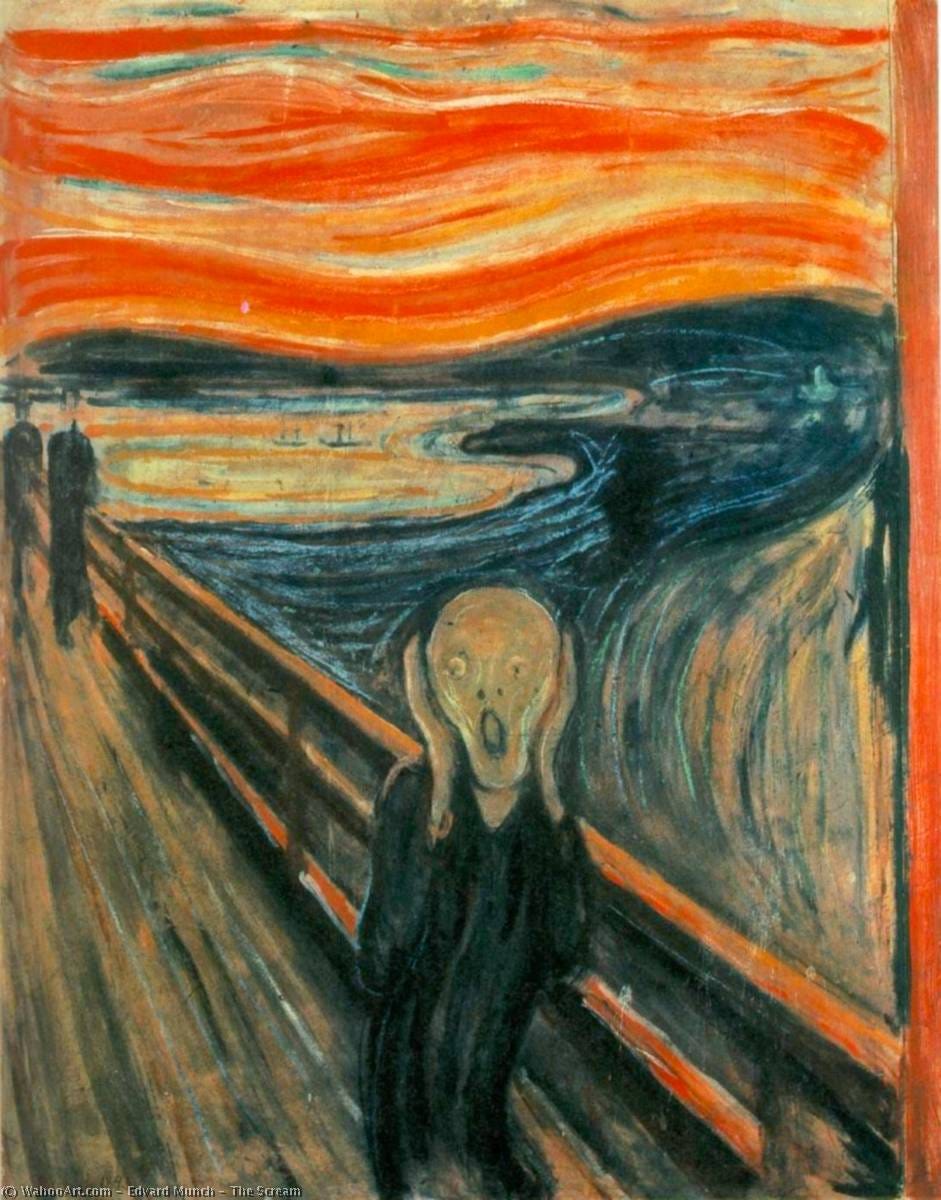
“There are more things, Lucilius, likely to frighten us than there are to crush us; we suffer more often in imagination than in reality.”
— Seneca, Letter 13
“Perceive at last that you have within yourself something stronger and more divine than the things which create your passions.”
— Marcus Aurelius, Meditations 12.19
His palms got sweaty, knees weak, arms heavy. He felt as if there was an infintie scream echoing through nature. It all felt threatening. He stopped. Aghast. Alert. Trying to process and prepare for it all.
The sky above the little town Kristiania- had turned red.
Edvard Munch, in 1892, felt like he was caught up in a sleep paralysis trance. Nobody else saw the terrifying emergency he was in. His two friends kept walking, oblivious of what he saw.
Soon, he got a hold of himself and followed his friends home. But what he saw that day never left him. It shook him to the core such that he continued to get anxiety attacks, random bouts of illness and debilitating psychological distress. This got increasingly worse and on one occasion he admitted himself to a Copenhagen clinic. In here, he kept painting to stay sane. Art became his salvation. The terrors of his life became material. This is how he got to produced the famous art piece- The Scream (see above).
That’s how panic attacks work. Your body can suddenly turn on you and a simple room, a road or seeing a plane can become an crisis in seconds. Your breath becomes shallow. You feel your heart beat on your throat. Suddenly, diarrhea feels inevitable. And the brain comes in with convincing conclusions- you’re about to faint. You’ll vomit. You’ll lose control. People will notice this and laugh at you.
I’ve seen this happen on the operating table time and time again. My patients will become agitated, certain that something bad is about to happen. They get crazy tachycardia and their blood pressure concerns the anesthesiologist. They repeatedly ask the same questions and seek re-assurance ever so often. Then they hesitantly approve the operation to proceed and a few hours later they wake up and they’re ok- a bit ashamed that they let a childish fear get to them. It turns out they were just suffering more in their minds than the reality they faced.
That’s our first point.
Let The Panic Come
Passengers cried out when a violent storm hit their ship while traversing the Ionian Sea. The ship’s pitching was worrying- it sang the end credits of their lives.
Aulus Gellius noticed and got surprised that the proclaimed Stoic philosopher he was traveling with had suddenly gone pale. And when the next blow died down, a wealthy man in the ship began mocking our Stoic- how tough they made themselves seem. How could a man who preached about self-control and courage look terrified when he met danger? The thing he was always preparing for.
The Stoic pulled out a book with the teachings of Epictetus and explained how our reactions come before judgment. Our body will recoil. It may suddenly become cold. We’ll shiver. Our face will sweat and the stomach will grumble. These first movements affect even the experienced mind.
To make it worse, this feeling worsens because we try to control it. You to try to fight the fact that you’re panicking. You force your heart rate to tone down. You hide your trembling hands from anyone’s view. You constrain the freedom of your breathe. And now your fear is not just against the threat, it has compounded into 3 or 4 more agitations.
According to the Stoics, what mattered most is what follows when we feel like shutting down or running away.
The most prudent move is to keep a straight face to save face while surrendering to the whims of your body. Acknowledge and accept that you might lose your train of thought. You might stammer. Perhaps you’ll feel the need to get to the washroom- fast. Somebody will notice that your voice now has a low pitch- you’re now talking to yourself instead of giving the presentation.
Let it all happen. And keep doing what you’re supposed to do.
We imagine this humiliation will stain our permanent record. But with repeated exposure you notice that no one cares, people cease to see you sweating, life has moved on- you and other people are now worried about something else. The people you fear seeing you at your worst are not even as perfect as you think.
You discover you’ll be ok.
Understand The Underlying Pattern of Panic
William James was worried that a deplorable situation he had witnessed would befall him.
He had spent most of his youth in severe psychological distress and was concerned he’d become like the patient he had seen in an asylum who- was sitting motionless, with his knees tucked against his chest.
His mind became his worst enemy. He’d wake up often because of night terrors. Struggle to be alone in the dark. And the more he stayed a lone with his thoughts, examining their texture- the more frightening and concerned he became to himself.
Then his health started to deteriorate. His career now became uncertain and he obviously became quite nihilistic. Anyone would. He asked himself if human beings had any real freedom at all or it was deterministic that he was doomed to always be tagged hither and thither by forces beyond his control. By this debilitating fear.
Good literature came to his rescue. He came across the beautiful work of Charles Renouvier- the man who defended human freedom in his work. This influenced him to come up with his life philosophy. He wrote in his diary that, “My first act of free will shall be to believe in free will.” He became the captain of his ship.
Of course his fear never went away. But he continued to live and work despite it all. He worked, married, and even built a riveting intellectual career around psychology and philosophy.
The effectiveness of this practice leads us to ask ourselves if what we feel is a product of what’s in front of us or a misplaced recurring thought, a product of a wounded childhood. Maybe you were once judged harshly when you tried to express yourself- that’s why you can’t stand giving a speech. Or maybe a crowded room gives you the feel of being trapped. And perhaps you’re a people pleaser because approval meant you’re safe and disappointment meant danger.
Understanding this deeper connection to your past gives you more empathy for yourself in the situation, helping you overcome the demons.
Remember You’re Powerful
Remember you have more agency now. Marcus told himself that he has something in him more miraculous than what moves him around like a puppet.
Most of what you fear or react to happened in a period when you had little power to influence your circumstances. You couldn’t have left home to go fend for yourself. You had to submit to authority if you were at the mercy of an abusive figure. The body remembers what happened long after you’ve grown all big and able.
But you must realize you now have choices. Leave the situation. Say no. Ask for help. Tell people to go fuck themselves. Resist stupid opinions. Speak your mind. Walk out of the meeting, the job, the relationship.
Repeat to yourself how much power you possess as often as possible- you have more than you think.
Stop Excluding Yourself
Cicero’s enemies waited on him to make mistakes in his speech. This became worse when his fame and success grew- the powerful Roman elites were watching and his work was becoming increasingly consequential. Just imagine the pressure he had before he made a major political appearance.
He worked anyway. He became one of Rome’s greatest speakers anyway.
He made sure not to think nervousness meant he didn’t belong.
Parties don’t always mean people accept you. Dates don’t only mean you’re desirable. Presentations don’t only mean you’re intelligent. And mistakes don’t mean you’ve been exposed as an imposter- I believe you’ve put in the work.
Allow people to think badly of you sometimes. You’ll one day look foolish to someone. Others may misunderstand you. You’ll disappoint someone. Or give a poor performance. But you must keep it light at heart. Have a sense of humor with it. Focus on what you control- your choices, judgements, actions.
As I always say, you’re a legitimate child of the universe.
Take the Catastrophe to Its End
In the end nothing matters.
Nihilistic as this may seem, Marcus Aurelius grounded himself in the fact. He’d imagine centuries earlier, in the age of Vespasian, where people got married, raised children, fought, complained, worried about money and their status.
These folks died.
Then another generation experienced similar conditions- they loved, schemed, fought, worried and believed they had colossal problems.
They also died.
This to say that over the scale of time, whatever terrifying or embarrassing thing you feel engulfing you right now won’t matter in 3 days, a week, a month. These people will eventually die, and with it their memory of your embarrassing moments. You’ll also die, and your problems right with you. I’ve never witnessed a dying patient worrying about some embarrassing thing they did 15yrs ago. Let mortality help you step out of the microscopic view of things.
This should free you. You can afford to fail. Or lose some aura- unlike fear informs you otherwise.
Keep Entering Life Boldly
He became sick with dread. The famous actor, Laurence Olivier, developed severe stage fright at the peak of his career. Imagine being considered one of the greatest actors alive and you’re suddenly afraid you’ll forget your lines. He even told his fellow actors during The Merchant of Venice to avoid looking directly into his eyes because it would overstimulate him. This state lasted for years. But Olivier kept returning to the stage. Acting. Doing what he was supposed to do.
And that’s what I want us to learn as the final lesson.
Avoidance works to mitigate a triggering situation. The problem is that you train your mind to cower from any anxiety inducing situation. You skip the party and your mind settles. You turn down a speaking opportunity. You cancel the flight and feel relieved. But fear controls you.
Soon you’re missing out on your life. You’re living a smaller life than is fulfilling for someone of your stature.
So keep facing yourself. Keep practicing what we’ve talked about today. That’s the only way out.
Previously,


Great suggestions for handling panic attacks. The most profound is to let is pass, go with it. I used to get panic attacks years before we knew what they were and I only had myself to guide me and I learned, just go with it, I would be OK afterwards. That began my healing. Most fears are based in our imagination and understanding that is profound. Buddhism helps with noticing thoughts and realizing not all thoughts are worthy of belief. Learning that was helpful too. We do have agency and all of us have the ability to direct our own lives, as fear is a misleading guidepost to follow. Thank you for this helpful article.
What if anxiety isn’t something to fight, but a call to return home to ourselves?
Maybe it’s just our younger self tapping us on the shoulder, asking us to remember what we actually need today. 🤍
Thank you for such a lovely piece, you connected the stoicism, art, empathy and tenderness 🙏🏻