


Welcome, dear reader! One of the harder things about practicing Stoicism is how much you can understand about yourself and still feel powerless to change. What interests me is whether you can come to recognize the moment before you sabotage yourself, and develop the capacity to decide what happens next. If you missed the last edition on We See And Hear What We Expect, you can catch up right here.

"We cry to God Almighty, how can we escape this agony? Fool, don’t you have hands? Or could it be God forgot to give you a pair? Sit and pray your nose doesn’t run! Or, rather just wipe your nose and stop seeking a scapegoat." - Epictetus, Discourses 2.16.13
You can be the friend everybody calls about a bad relationship and still pick up the phone when the person who’s made you miserable for six months calls to say they miss you. You know what those words are worth. You also know how badly you wanted to hear them.
By evening you’ve agreed to see them again, and when a friend asks how you’re doing, you leave that part out.
There’s an interesting type of shame in getting hurt in a way you saw coming. It may take you a few months to get over the person and considerably longer to admit how much of what you called love was the relief of feeling wanted again. But even that discovery would be easier to live with if you could trust yourself to choose otherwise the next time you meet somebody who makes you feel that good.
And that’s one of the lonelier things about being able to see yourself as you are. People hear how well you understand your predicament and assume you have some power over it. But we both know it’s embarrassing to have to tell them you’re still struggling with the same thing you solved the last time you spoke.
you know what you should do but…
Augustine once asked God for chastity and was frightened He might grant it too soon. He still wanted to sleep with the women he desired.
Years later, a visitor told him about two men who’d come across the life of Saint Antony and made up their minds there and then to change the course of their lives.
After the visitor left, Augustine turned on himself. He had spent years learning what he thought a man needed to live well, and here were men who’d managed in an afternoon to do what he was still preparing himself to do. His old excuse had been that he needed to understand a little more. What excuse did he have now?
We can be just as incredulous about ourselves. You lose your temper with someone you love and afterward you watch yourself in high definition saying the very thing you knew would hurt them. It’s shameful to admit you meant it in the moment. More shameful still if you’ve apologized for it before. And since you can give such a good account of why you do this, anyone hearing you might reasonably assume it’ll be easy for you to stop.
There’s another possibility, which is that you understood exactly what you were doing. And at some point in the argument you gave up on getting the other person to grasp your perspective and started looking for what would hurt them.
What troubles you afterward is having to make room for that fact in the opinion you have of yourself.
some of what you discover is true
You might hear that somebody has done well and it bothers you, particularly if you’ve privately considered them less intelligent than you. Their success brings up the uncomfortable measure of what you’ve done with your intelligence. You may know you have the ability to do good work but have very little to show for it. Some of the circumstances that held you back were beyond you. Some of them you had a hand in. Envy makes it painful to sit down and work out which is which.
Then there’s the more humbling and somewhat painful experience of looking at something you’re proud of and realizing how easily your life could have gone the other way.
Think of a time somebody took a chance on you. They could have just as easily given the opportunity to somebody else, and that person would’ve had the years of practice, the income and reputation you do.
Even the confidence you count among your better qualities, you owe it to having been given a chance when you had very little evidence you were competent in the work.
Follow that thought far enough and you can feel quite small. So much of what you have, and some of who you’ve become, has depended on the universe being kinder to you than it had any obligation to be. You realize you’re not as powerful or in control as you think.
This is where it’s necessary to buy into delusion for a bit.
For the life you dream of can turn out to be harder than you imagined. Say you’ve taken up a skill and you’re at bottom of the barrel. You have enough taste to see how badly you do it, which makes practice an unpleasant hour in the company of somebody whose work you can hardly stand.
If you take your opinion of yourself too seriously, you’ll quit at the point where it would’ve paid to persist. And if you’re envious of what someone does unusually well such that you feel like an imposter, you can turn that feeling around. You could spend your time finding out how they learned it, try it yourself and come back tomorrow with a little more evidence about the kind of person you could become. That evidence can also accumulate in ordinary ways. You can aim to fill your days with reading, finishing what you sit down to write, going to bed when you said you would. And in time you have a positive history with yourself and direction that you no longer indulge envy.
I’ve become more accepting of myself when I encounter such disconcerting revelations- because at the end of the day, that’s just the truth of who I am and what I feel. I won’t repress it and become hypocritical of the matter. I know I’m the one who’ll have to live with myself and I don’t have to live with a fractured psyche.
I’m human and I give myself compassion for that.
That said, I’m always trying to be a better person, and I’m sincere enough to know that it’ll take a godawful amount of time and I’ll slip and fall back no matter the progress I may have made. And that’s okay- as long as I’m always picking myself up and trying to mend my wrongs as much as I can so that in summation there can be more rights than wrongs.
what you can do once you’re self aware
What I argue against in some self-help books is the intellectual pleasure of knowing this and that about yourself while remaining essentially powerless in the situation you bought the book to help you with. That’s why the question I’d ask of anything you discover about yourself is whether it helps you move forward.
Take someone who’s come to understand that she’s an introvert. She can tell you why she finds a room full of strangers exhausting. Over time, she comes to think that making connections is something available to extroverts, but each invitation she declines saves her from having to find out whether that’s true. A sound observation about herself has started making decisions on her behalf, and possibly her life’s trajectory.
But suppose she asks someone she’s interested in to a soirée. She’s now found a way to build a connection in the close quarters she prefers. Next time she may feel like turning up her energy a little and socializing beyond her comfort zone.
If you know how anxiety manifests in you, the moment your voice begins to shake you may start being hyperaware of it as if everyone has noticed. Now you’re trying to work out how much composure you’ve lost in their eyes, and you miss what somebody may have said to you. Or you lose your place halfway through a presentation.
That’s why we have to be active in our rescue. Your voice may shake for the rest of the conversation but you can practice courage and say what you mean. If you’ve lost your place, you can look down at your notes, find the point you wanted people to understand and pick up from there.
Each time you give yourself a little room between the self-judgment and what you do next, you have a say in what becomes your character- no longer trapped in the echoes of self-awareness. And that’s what’s progressive.
The next time the phone rings and somebody says they miss you, you may still want them as badly as you ever did. You can admit how good it feels to hear their voice. You can even tell them you miss them too.
But what you agree to do or not do about it is a decision you still have to make, .
My books:
The Tools — Ambition asks a great deal of your mind and body. I wrote The Tools to help you meet those demands. It covers how dopamine shapes motivation, how to structure your day for deep work, and how to use exercise, nutrition, sleep, and Stoic practice to sustain your energy when the work gets hard.
The Best of Marcus Aurelius — I’ve read Meditations more than a hundres times. What’s in this book are the passages I keep coming back to, arranged around eleven themes so you can find Marcus when you need him most. Open it when someone has tested your patience, when pain becomes too much, or when you’ve been so busy getting through the day that you’ve missed what was beautiful about it.
You can buy either book on its own. Both are included with an annual or lifetime membership to The Stoic Manual.
Stoic Community:
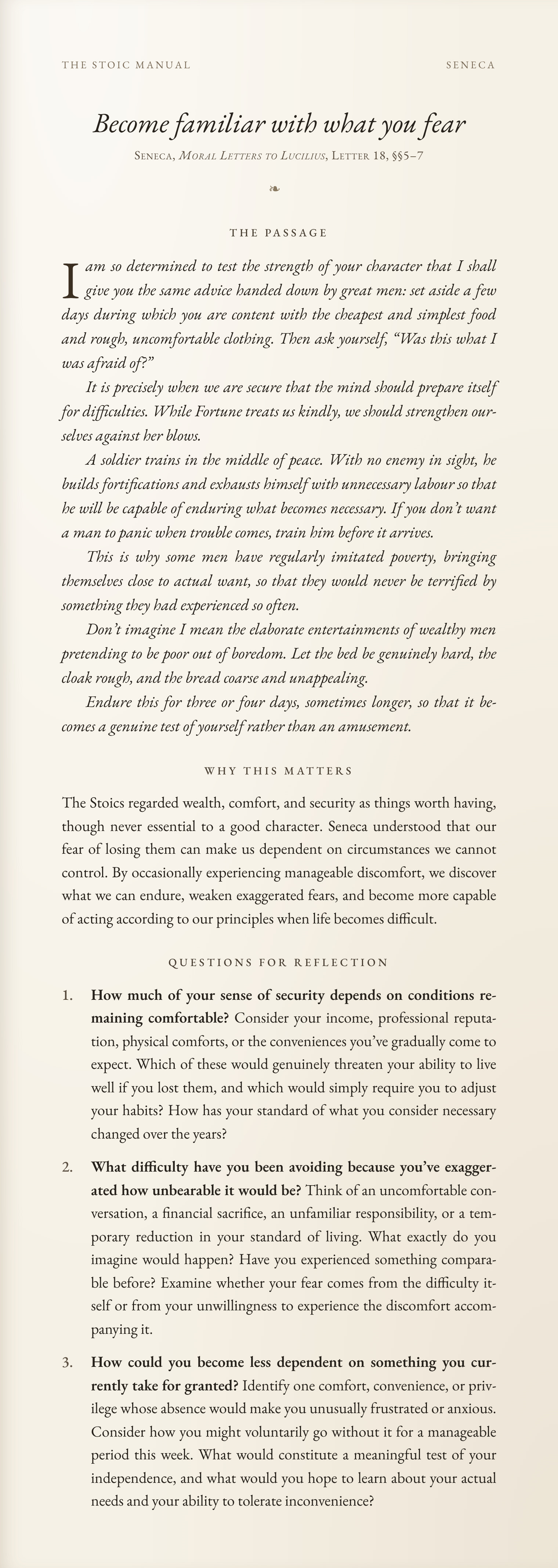
It’s easier to read about Stoicism than to practice it. Try the passage below with a situation you wish you’d handled better. If it helps, join me and other paid readers for a few minutes of practice each day in Stoicism Together.
‘Til next time. Have a good day ahead!
With love,
Antonius Veritas, M.D
Interesting read 🩷
That part at the end , where you called me by my name 🤣🤣I did not like that !