


Welcome, dear reader! See, a mistaken judgment can cost you a good relationship, make you dismiss useful advice, or lead you to trust someone who means you harm. For those of us practicing Stoicism, this makes examining our impressions a daily responsibility. As what we expect from people is the subtle force influencing how we relate to them. If you missed the last edition on How to Change Your Career Without Starting From Zero, you can catch up right here.

“Share all your worries and thoughts with your friend. Believe them trustworthy, and you’ll help them become trustworthy. Some people, through their fear of being deceived, have taught others to deceive them. Their suspicion has given their friend an excuse to do wrong.” - Seneca, Moral Letters to Lucilius, 3.2–3
Othello kills his wife believing she has betrayed him.
And by the time he discovers she was innocent, it’s already too late- the man who wanted to ruin him has succeeded in his sorcery.
In this Shakespeare’s tragedy, Othello is a respected military commander married to Desdemona. One of his officers, Iago, resents him and decides to destroy him by making him believe that Desdemona is having an affair with another officer, Cassio. Othello trusts Iago, they’ve been through thick and thin together.
Iago begins with things easy to make look suspicious. Cassio has lost his position and asks Desdemona to help him get it back. So she speaks to her husband on his behalf. Then once Iago insinuates that she has feelings for Cassio, her efforts to help him begin to look like evidence of an affair such that the more she pleads his case, the more Othello has to suspect.
Then Desdemona loses a handkerchief Othello gave her. It falls into Iago’s hands, and he secretly leaves it in Cassio’s room. Cassio finds it without knowing whose it is. Iago then tells Othello that he has seen Cassio with it. Every little detail is pointing to the betrayal.
Still, Iago goes further. He has Othello watch from a distance while he gets Cassio talking about another woman. Cassio laughs, unaware that he’s being watched. Othello believes they’re discussing Desdemona and interprets the laughter as a man boasting about sleeping with his wife.
He now feels he has seen enough proof.
So Othello confronts Desdemona and refuses to believe her denials. He ends up strangulating her. And when Iago’s deception is finally exposed, Othello learns that the affair existed only in the story he had been persuaded to believe. He has killed the love of his life while taking guidance from the devil on his shoulder.
That’s the danger we have to recognize in ourselves- we can be so certain about who people are that everything they do seems to prove us right.
what you expect influences what you see
This phenomena is most apparent in social settings, where how you think about others influences what you notice in them and broadly how you relate to each other. If you think someone is great, everything they do seems to confirm that idea. If you see them as suspect or untrustworthy, there are things they’ll do that turn out to be innocent, but to you they’re an affront to your safety or a breach of trust.
You dismiss advice that would have saved you because you don’t like the person giving it. You overlook an opportunity because someone you don’t vibe with or view as inferior has taken a path in that direction. You make an assumption about your partner’s intentions, respond to them as though it’s already proven, and find yourselves fighting over something neither of you understands.
Sometimes you’re pissed off, hyperalert, or defensive whenever a person talks, before you even know them well. You’re going off what you’ve heard or gleaned from their reputation. Your body language doesn’t help, and eventually a remark slips out that reveals what you’ve been thinking about them all this while. Then they become guarded around you and you wonder why you lack friends.
It’s tough to make your case to someone who has already decided what kind of person you are. You can’t dig yourself out of that hole. But it’s worth considering how often we put others in that position.
why are you thinking this about someone you love?
I’ve read competence as arrogance and kindness as a strategy to lure me into manipulation. Even when someone was being kind to me, I could read too much into an innocent thing because I had a particular belief about them.
At one point, I asked myself why I was having such thoughts about someone I claimed to love. If that was what I thought of them, shouldn’t we just break up? For sure, it wasn’t healthy, and I wasn’t having fun.
That’s how I knew something needed to change.
The difficult part is that the person eventually did deceive me. Some of what I suspected turned out to be true. But at the time, in particular moments I’d questioned, they hadn’t been doing anything wrong.
Humans can be complex, and it’s hard to get a consistent read on someone. A person can be kind and later betray you. You can recognize a pattern and still misinterpret a moment’s conversation. Experience should help us become more discerning about how much access and involvement we allow someone based on the judgment of their character as a whole.
check the state you’re judging from
Your thoughts color how you see and interpret the world to a great extent. Before I trust my reading of someone, I have to consider whether I’m jealous, low, apathetic, or preoccupied with other forms of low vibration in the abysmal darkness of human nature. Such that if I’ve spent the whole day expecting the worst, it factors in to the meaning I’ll give someone’s words.
This is where the Stoic practice of examining our impressions becomes useful like we do over at Stoicism Together.
Asking, “What did you mean by that?” gives the other person a chance to explain before we make a decision from an assumption and act it out. Their answer may reveal something unpleasant. It may also divulge how much we added to a sentence we barely thought about.
The point is that I’ve given the person a fair hearing and that my response has some basis beyond the mood I brought into the room. And when in doubt, a lack of eye contact or a fake smile can mean several things. Also, what someone repeatedly does- whether they follow through, and how they treat people with less power give me more to work with.
lead with love and curiosity
The best approach I’ve found in fine-tuning my expectations of others is to lead with love- to want the best for others, see the good in them, and wear my heart on my sleeve. That takes courage when you know people can take advantage of it.
I have to remind myself that betrayal, mischief, or sabotage can’t hurt my soul; it can’t decide what kind of person I become. They can hurt me and perform actions with real consequences, but I still have a say in how I live afterward. That belief makes it easier to trust someone- to meet them without demanding that they first prove who they are- which no one can ever do fully even when given decades.
If they’re good, they may do their best to reciprocate the trust and love I give them. Some won’t. I can be warm, generous, and interested while keeping sensitive information private, making small commitments, and watching how they react under pressure or temptation. There’s room to enjoy someone’s company while learning how much I can give and share with them.
The same attention has to work when I like someone. If I keep excusing their behavior because I think they’re great, I’m still seeing what I expect and it might blind me to sinister parts of their character. Trust and verify applies to the people whose company we enjoy too.
time reveals what you can’t see
This matters when you’re considering a business partner, mentor, marriage, or a life-changing involvement. Approaching people with an open mind gives them room to speak freely and reveal themselves. Hence the saying that if you want to catch a liar- just go with the flow and eventually they’ll snitch on themselves or reveal an inconsistency uncovering their ruse. Just listen without announcing every suspicion or rushing to tell them who you think they are.
There’s something of “playing a fool to catch a fool” in it, though setting traps can give you another complicated interaction to misread. Ordinary commitments already reveal a great deal: how someone handles disagreement, responds when you say no, admits a mistake, or behaves when keeping their word becomes inconvenient.
Over time, those instances connect. You don’t need to wait for something catastrophic before deciding you can’t allow someone in your life. Equally, continued evidence of goodwill should be allowed to change an unfavorable opinion. This approach requires being student of human nature where you’re always observing and learning from the variety of people you meet.
After a relationship or friendship turns sour, a postmortem can help you understand what you overlooked, what you assumed, and what you’d do differently. That’s how experience can improve your judgment. But the next person still deserves to be observed in their own right.
That’s how, dear , I want you to go into your next consequential conversation willing to have a good one. Aim to have fun. And when in doubt, ask what you need to know, let the person make their case, and allow what they do to change your mind.
Also, remember it’s easier to read about Stoicism than to practice it, though practice is where we gain the most. Questioning your assumptions can be difficult when you feel certain you’re right. But having a guided practice can help you notice what you’ve missed and apply what you’re learning. You’re welcome to practice with us.
Example of our guided group practice you can apply right now,
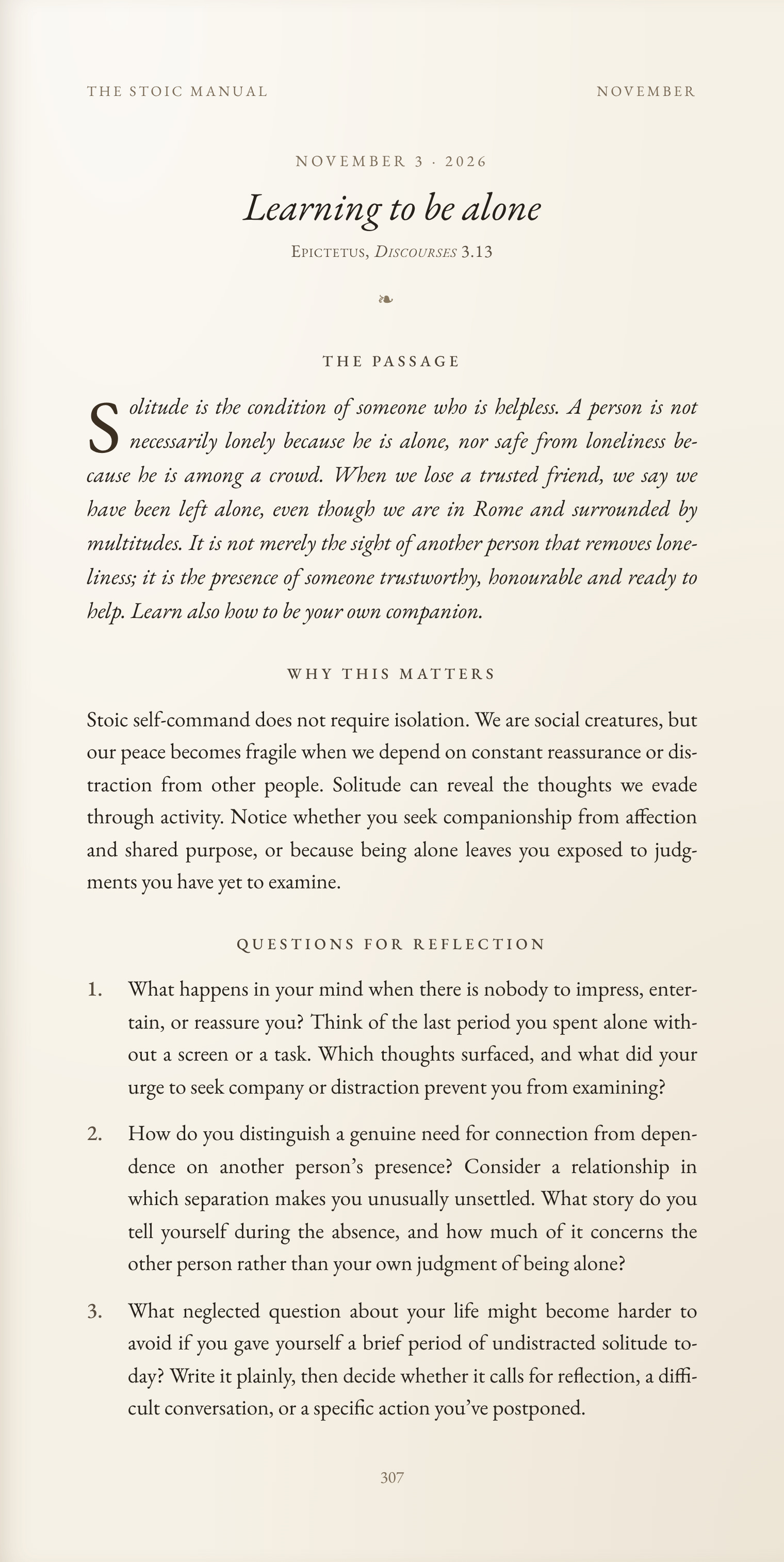
‘Til next time. Have a good day ahead!
With love,
Antonius Veritas, M.D
Ordinary commitments are the easiest way to test a possible business partner. Before you sign anything, do one small paid project together with a clear deadline. Then you can see how they handle a missed date, a no, or their own mistake. That shows you more than months of friendly talk, and it costs little if it goes badly.