The Questions to Ask Before You Waste Your Life
5 questions the Stoics would ask you before you wast your life.

Welcome, dear reader! Nobody sets out to waste their life. It happens a day at a time, through questions we never stop to ask, until we look up and the years are gone. The Stoics treated this as the most serious problem a person can have, because time is the one thing we can’t earn back. These are the five questions I ask myself so it doesn’t happen to me. If you missed the last edition on The Quiet Anger of Being Understanding, you can catch up right here.
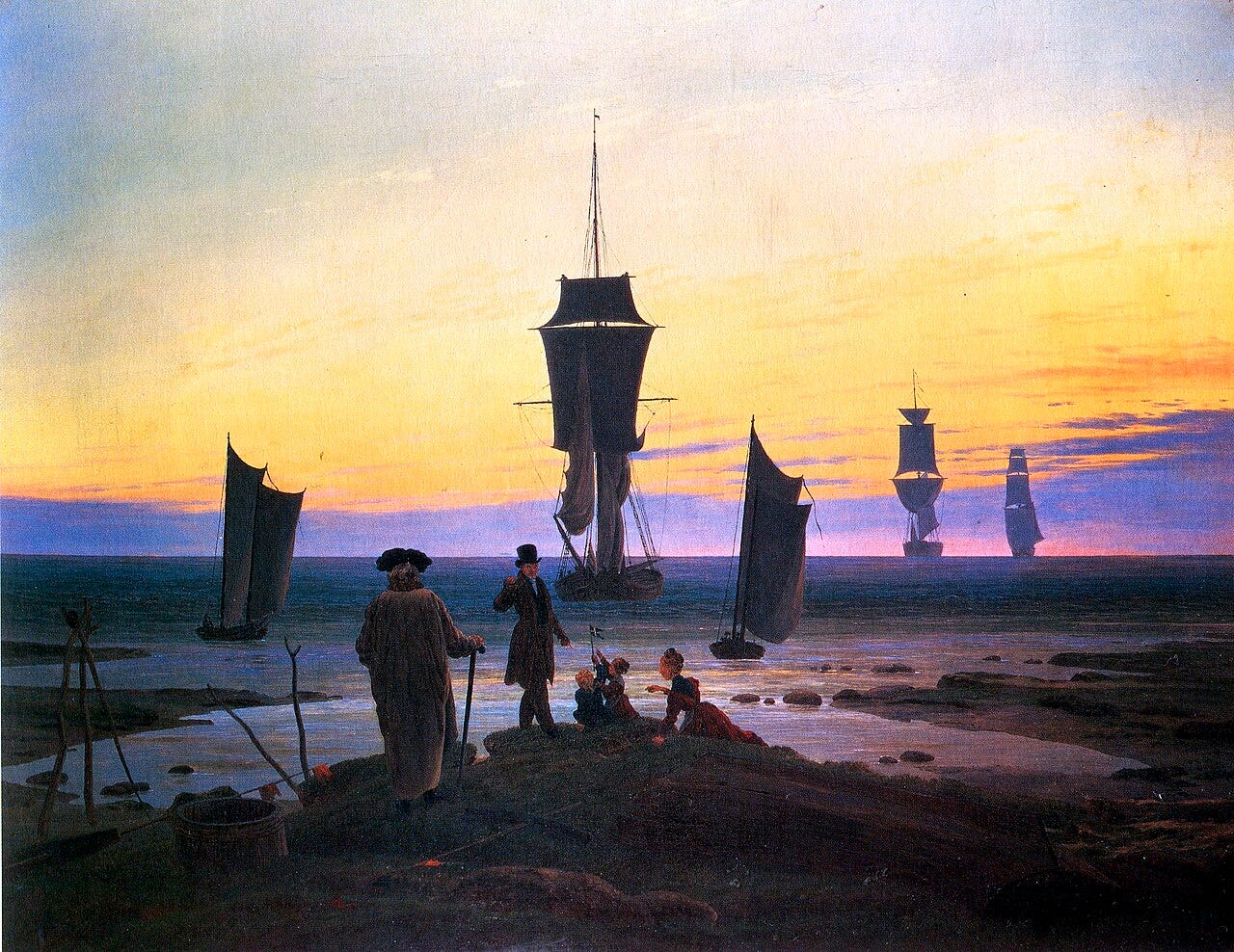
“Do not act as if you were going to live ten thousand years. Death hangs over you. While you live, while it is in your power, be good.” - Marcus Aurelius, Meditations 4.17
I’d gone back home to visit mother when I saw him.
He was my neighbour when we were young, and my friend. I was surprised to find him in such a pitiable manner.
I even felt a bit guilty for making it out. Not to say I wasn’t dealing with my own set of problems, or that I was some billionaire. But at least I wasn’t caught up in the same area I grew up in, which hasn’t developed much in decades. Yes, a place like that was pivotal to my foundation, I’m grateful- but it’s constancy also makes the mind dull. At least I wasn’t still depending on my parents, you know.
And it wasn’t just one person. It was almost everyone I knew from my age. People who looked promising and full of energy had descended into begging and stealing, and become mediocre versions of themselves.
It’s true that luck and upbringing contribute to anyone’s trajectory.
But what the fuck man!
Is life really that unfair, or do we have a say in what we do and how we deal with the struggles in front of us? Is there a way to think that can lift us from the mud and usher us into the world of expansive probabilities? And if there is, why is it so hard?
Then it hit me. It’s because of the ideas one learns as they explore the world. Schopenhauer saw that the world a person lives in is shaped chiefly by the way they look at it, which is why no two people view a similar situation the same. They color it with their innate perspective. Their fears and insecurities.
The questions we ask ourselves mix that palate. And these are the ones I keep asking to stay sane and progressive.
1. What’s the meaning of life in an absurd world?
This is the question that has bothered me for the longest time. Everything else hinges on it.
There’s no way to dilute this fact- we’ll all die one day. Everything we’ve ever cared for, loved or struggled to build will end together with us on a long enough timeline.
Essentially, we’re building sandcastles.
Which brings a more stringent question. What’s the need to be invested in or attached to anything if the summation of all our effort is nothing?
In some Tibetan monasteries, monks spend days building a picture they already know they’ll destroy. It’s called a mandala, and it’s made of colored sand.
They bend over a table and pour the sand a few grains at a time. It’s slow, careful work. Taxing. One wrong move of a sleeve can ruin hours of it. And when that happens, they don’t complain. They fix it and keep going.
Then the picture is finished. They pray over it, sweep the whole beautiful thing into a grey heap, carry it to a river and pour it in.
Nobody cries over this destruction or feels like it’s wasted effort.
Children know this too. They have fun building sandcastles, only to watch the high tide destroy them. I believe that’s how we should live too. We ought to take the building just as seriously, even if the dying sun will take us with it. We ought to have fun in the process.And we’d rather laugh than cry at our great tragedy.
The meaning of life is what you choose to do, or what is important to do at any given moment, even if you don’t like it.
2. Are you following your path, or the one chosen for you?
I came closest to wasting my life by believing I should just focus on my undergraduate studies, as my parents had advised. What my father told me felt reasonable, because focus is quite important. But I couldn’t brush off the fact that sometimes I had extra time and could put it to good use.
It was my sister who encouraged me to pursue a writing career and see what could grow from it. Then I had to believe I was capable of so much more, and had so much more to give the world, to endure the long periods of study and the long writing and reading sessions.
Covid handed me the same choice. I could watch endless TV shows, because granted, what else was there to do other than try not to sink into the perils and depression of boredom? Or I could read books, even if I didn’t know where they’d end up helping me. I’m glad I made the best choice. I can’t imagine my life without having exposed my mind to life-changing business, writing and philosophical ideas.
In 1948, Chinua Achebe won what any family would want for a son- a scholarship to study medicine at University College, Ibadan. His future looked settled. They’d finally catch a break.
But within a year he knew it wasn’t his path. He loved stories and books. So he dropped medicine and switched to English, history and theology.
It came with a price. The college took the scholarship away, and his family could hardly support him. Then his older brother stepped in. He gave up his own travel money to pay the fees.
Achebe stayed in class. And 10 years later he published Things Fall Apart. A classic.
Sometimes it’s dizzying to discover that you have freedom.
You’re free to choose the best path for yourself or just sink into laziness. You’re free to push yourself or not. You’re free to care enough about your work or not. Either choice carries a price, and it bids you to choose the best one at any moment. That can be scary for a lot of people, especially those who have depended on a parent or guardian to help them make decisions for the longest time. Suddenly everything feels so urgent. You can’t yet see how things will play out, and there’s no confidence animating any of your stratagems.
Until you sit down, come up with a set of values and reflect on what you think is your mission here on earth, so that at the end of it all you’re good with whatever choices you’ve made.
Are you afraid that you’ve wasted your time pursuing something that wasn’t yours, and that it’s too late to begin again? Or is this what you’d really want if you had all the choices, time and resources in the world?
What lifestyle do I want to live for a long time? If I had everything in the world, what would I work on?
A lifestyle outlasts goals that end at a specific time or date. Even if you accomplish this or that, even if you get to live or die over a set period, you’ll still be fulfilled and happy knowing you spent it getting better at what you want.
3. What does doing my best look like, and am I doing it?
You can still walk a chosen path badly.
It’s easier to blame our success or failure on our circumstances than on ourselves. Which is why it helps to look in the mirror whenever things go wrong. It hurts, yes, particularly if we’re the source of our trouble. But that’s also how we get to solve our issues and move forward.
In October 2020, Eliud Kipchoge lost. He was the only man to have run the marathon distance in under two hours, and he hadn’t lost a marathon in seven years. That day in London, he finished 8th.
People started asking if he was finished. But he didn’t panic. He went back to his training camp at Kaptagat.
There he did what he had always done. Back to the basics. He slept in a plain room. Took his turn cleaning the toilets with the younger runners. Documented every training session in his notebook, then showed up for the next one.
Ten months later he won his second Olympic gold.
This is why we have to look at what the best in our fields do, how they work, how they manage themselves and others, then emulate them as much as possible. That way we have a standard of practice that leaves the matter of the score to time and a bit of luck.
“A prudent man will always try to follow in the footsteps of great men and imitate those who have been truly outstanding, so that, if he is not quite as skillful as they, at least some of their ability may rub off on him.” ― Niccolò Machiavelli, The Prince
We risk wasting our lives if we don’t measure and follow through with what our best looks like.
4. What’s the most important thing to me?
Your best has to be spent on something, and there isn’t enough of it for everything.
Given how short life is, and that it can end at any time, it’s important to decide what’s important to you, because you’re the only one who’ll feel the pain of regret when the end nears.
This might not be a common path. It might not make sense to anyone else. It might earn you some enemies. But it’s good that you know this thing and create time to bring it to reality, no matter the odds, and no matter the competing interests looming in the background that threaten or promise us a good time. It’s this knowledge that helps you measure whether you’ve really wasted your time or not.
In Tolstoy’s story, Ivan Ilyich is a judge who has everything a respectable man should have- a good salary, a proper wife and a new apartment.
One day he’s up a ladder hanging the curtains when he slips and knocks his side. It looks like nothing. But the pain doesn’t go away, and no doctor can cure it. Next he’s on his deathbed.
At first he’s angry. He did everything right, so why is this happening to him? He goes back over the respectable life he built, looking for comfort. Instead, a thought lingers that he can’t push away- what if I’ve lived my whole life the wrong way?
He fights that thought for days. And only in his last hours does he admit it’s true. He stops thinking about himself, feels sorry for his wife and son, and his fear of death leaves him.
Tolstoy had warned us on the early pages that this life was “most simple and most ordinary and therefore most terrible.”
I think of him when I meet a person who feels comfortable, who doesn’t have any ambition to do anything of their own, or to push themselves and see how grand and beautiful life is once they take the leap. What they’re getting wrong is that there reaches a point where they won’t have to work any more.
For our sanity’s sake, there’s no point like that.
We humans can’t survive doing nothing- at least not for long. We might reduce the scope and effort of our actions, but ultimately we always need something meaningful to do, or what we call work these days. And we can’t stick to work just for the compensation- it has to be so deeply entwined with who we are that we wouldn’t imagine ourselves not doing it, not in the abundance of pleasures, nor in the deepest of pain.
Epictetus says that as long as you aim to keep your mind and actions in accordance with nature, and take and use things as they happen, not as you wish them to unfold, you won’t have cause for regret, because you’re employing every bit of time and energy on yourself, your life.
That’s why anyone who chooses improvement, or eudaemonia, the flourishing life, over worldly matters is very hard to rattle or inconvenience. They know how to use circumstances to their advantage. It’s hard to find them in situations where they’ll waste their life, because they’re not thinking along those lines.
5. What’s not endurable about this moment?
Marcus Aurelius asked himself what, viewed objectively, was not endurable about a particular hard moment.
He was ashamed to answer.
I’ve seen a colleague let addiction destroy them because they couldn’t stand grief. They had lost a friend, and I think they blamed themselves for it. They would have made a brilliant doctor. But they continued to dig deeper into the hole they were handed, and kept emerging from the void with another problem.
Then two.
Then three.
They couldn’t sustain relationships with anyone close to them. They became insufferable at their work and in their family.
And sure, there was pain. I can relate to what they had to experience. They’re still trying, but they could be better, given the time that has passed. I say that with empathy, and because telling the truth even when it hurts is the best way to help anyone.
No matter the cards we’ve been dealt, it’s possible to come out sober and with a way to live going forward, rather than cope with escapism to no end. We can process our hurting emotions in a much better way, just as people have done countless times in history.
Viktor Frankl walked into Auschwitz with his life’s work hidden in his coat. It was a book he had spent years writing, and he had sewn the pages into the lining.
Within hours the coat was taken from him, and the book with it. Then things got worse. His wife, his parents and his brother all died in the camps.
He could have given up. Instead, he decided to write the book again. In his last camp, sick with a high fever, he stayed awake at night and wrote it out in pencil on scraps of stolen paper.
He survived. He published the book. And he shared a formidable line from Nietzsche’s work with the world- he who has a why can bear almost any how.
We can feel pain and still do our duty. That’s life, more so if this duty helps us express our love for the world.
on the bow that’s always strung
Can someone become so concerned about wasting life that they struggle to enjoy it?
Yes.
One day a man from Athens found Aesop, the famous storyteller, on the ground playing a game with a group of boys. He laughed at him and called him a madman.
Aesop didn’t get angry. He took a bow, loosened its string and placed it on the road. “If you’re so wise,” he said, “tell me what this means.”
The man looked at it for a long time. He couldn’t work it out, and gave up.
So Aesop told him. “If you keep a bow tightly strung all the time, it will soon break. But if you loosen it, it will be ready when you need it.”
That’s why it’s crucial to have time to just wind down, relax, or even think of our place in the cosmos, to put perspective into situations. We should take it as play. It’s good if we loosen up a bit, explore and enjoy the world around us.
before the tide comes for us
Marcus would remind himself that life is warfare, and a journey far from home. We’ll die soon. The sooner we accept this fact rather than dispute it with an indifferent universe, the easier it becomes not to waste our lives and to build a life we love.
The myriad distractions of modern life will steal our productive time if we let them. But we control where our attention goes, and whether we’re doing the right actions even when distractions from the outside compel us to indulge them.
We’re sovereign. We’re greater than the things that play us like a puppet to no benefit.
We owe it to ourselves to fight for the life we want to live with courage and discipline, so that in the end we don’t have regrets.
You’re made of so much more. Imagine what a decade’s worth of courage, discipline, justice and wisdom can do for you. If not for the pleasure of practising the virtues, then for the outcomes you’re likely to get in the real world, as a reflection and expression of the greatness you are, dear .
Go forth!
‘Til next time. Have a good day.
P.S: Below is part of what we do in our Stoic Community. Because the best way to learn and get the most out of Stoicism is through practice. Seneca emphasizes that, “words must become works.” I’d love for you to join me and other paid readers for a few minutes of practice each day in the Stoicism Together Club. It’s included with your membership.
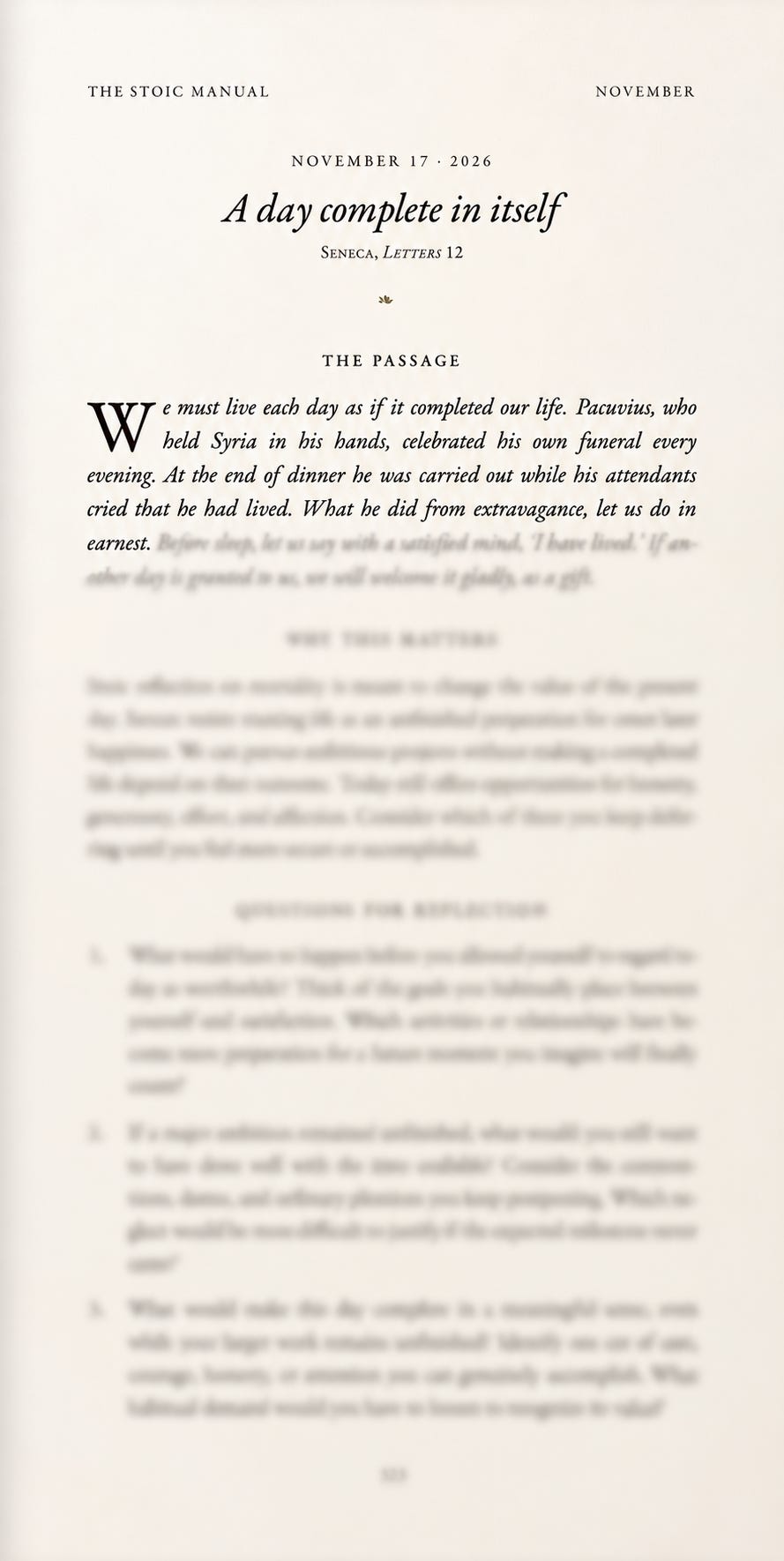
Upgrade in web for subsidized prices.
My books:
The Tools — Ambition asks a great deal of your mind and body. I wrote The Tools to help you meet those demands. It covers how dopamine shapes motivation, how to structure your day for deep work, and how to use exercise, nutrition, sleep, and Stoic practice to sustain your energy when the work gets hard.
The Best of Marcus Aurelius — I’ve read Meditations more than a hundred times. What’s in this book are the passages I keep coming back to, arranged around 11 themes so you can find Marcus when you need him most. Open it when someone has tested your patience, when pain becomes too much, or when you’ve been so busy getting through the day that you’ve missed what was beautiful about it.
You can buy either book on its own. Both are included with an annual or lifetime membership to The Stoic Manual.
You know what, every one whose soul is not “ Free” , is wasting his life….its long topic but i have weitten in short..i will explain the details soon in my upcoming article
I read a few lines of Meditations every day. And I now have another stoic source to consult regularly. If you make an attempt at Stoicism, you need to follow The Stoic Manual.
Memento Mori