Rest Before You Begin to Resent Your Work
November 22: Seneca on rest.

Welcome, dear reader! If you missed yesterday’s daily Stoic practice on You Don’t Have to Win Every Negotiation, you can catch up right here. Or if you missed the last essay on The Questions to Ask Before You Waste Your Life, you can reflect on it here.
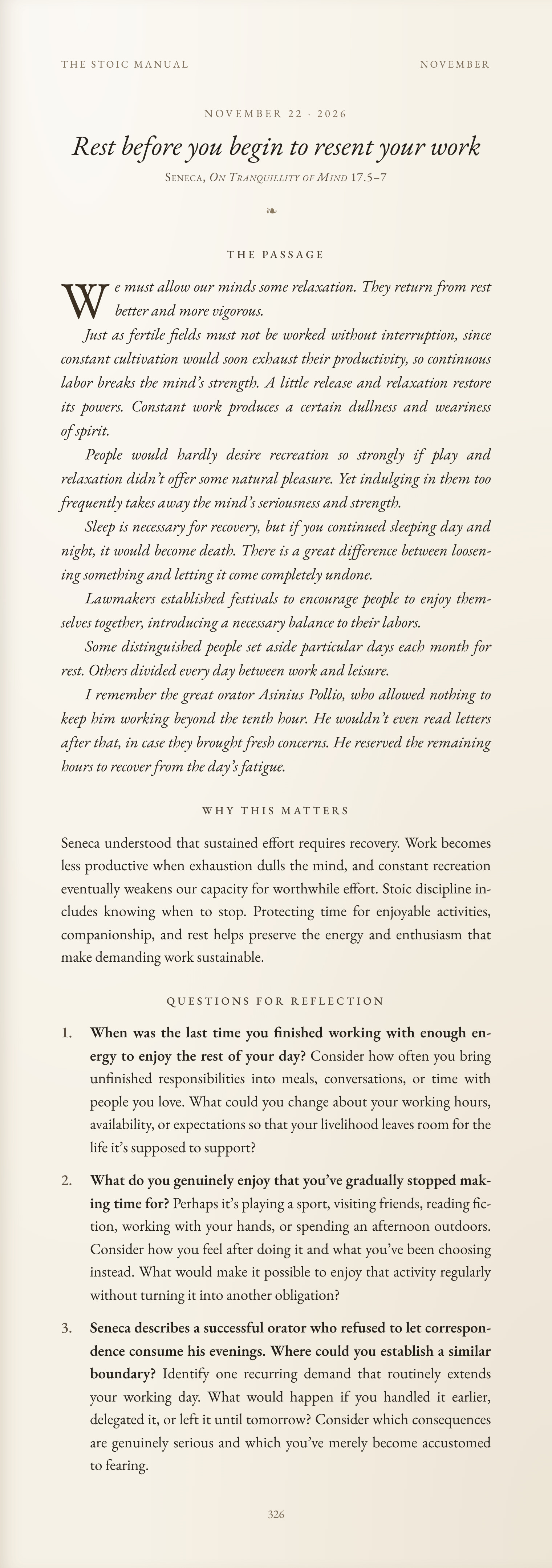
On today’s daily Stoic Practice, Seneca tells us to reflect on the balance between rest and work. He encourages us to protect time for enjoyable activities, companionship, and rest so that we can preserve the energy and enthusiasm that make demanding work sustainable.
That’s part of what we do in our Stoic Community, dear . Because the best way to learn and get the most out of Stoicism is through practice. Seneca emphasizes that, “words must become works.” I’d love for you to join me and other paid readers for a few minutes of practice each day in the Stoicism Together Club. It’s included with your membership.
Upgrade in web for subsidized prices.
My books:
The Tools — Ambition asks a great deal of your mind and body. I wrote The Tools to help you meet those demands. It covers how dopamine shapes motivation, how to structure your day for deep work, and how to use exercise, nutrition, sleep, and Stoic practice to sustain your energy when the work gets hard.
The Best of Marcus Aurelius — I’ve read Meditations more than a hundred times. What’s in this book are the passages I keep coming back to, arranged around 11 themes so you can find Marcus when you need him most. Open it when someone has tested your patience, when pain becomes too much, or when you’ve been so busy getting through the day that you’ve missed what was beautiful about it.
You can buy either book on its own. Both are included with an annual or lifetime membership to The Stoic Manual.
Seneca's point has good modern support. Sabine Sonnentag's research on psychological detachment finds that people who mentally switch off from work in the evening report less exhaustion and more engagement the next day. The catch is that rest only counts if the mind leaves the job too; an evening spent checking messages on the sofa barely registers as recovery. Writing down tomorrow's first task before closing the laptop is a simple way to make that switch.
done