

Epictetus tells us that we’re always reinforcing what we do. No other place is this truer than how we pay attention. He warns that the more we’re accustomed to giving in to distractions, the harder it becomes to correct the flaw and the more doomed our fate becomes.
His main concern was the mind- about the weak judgments we come to accept, the terrible impulses we permit ourselves and how we treat people. Why? Because attention is how we notice ourselves doing wrong or going astray and how we get to choose the best response around a situation. Consider how we talked about the value of delay when you’re angry and how you can train your attention to anticipate and capacitate it.
The Swahili have a proverb- haba na haba hujaza kibaba. It means little things snowball into huge ones. It mostly applies to saving money, but the opposite is also true. If we lose our attention and treat a person rudely, the next time it gets harder to practice kindness. If we lose the battle to laziness today, the next day it gets harder to get out of bed. Even procrastination begets procrastination, and a largely unlived life.
Aesop once wrote about a dog who lost everything. He was carrying a huge chunk of meat across a river when he saw a reflection that looked like another dog was carrying an even bigger piece. So he drops his chunk and reaches to snap the other one. But this is how the river carries away his juicy steak. Stupid, right?
This is exactly what happens with our distractions. The grass always seems to be greener. We lose the precious time, good life and good things we have in pursuit of an illusion and wonder why we’re busy but unaccomplished. Spent but unhappy.
A new book, article or Youtube video seems to offer a new discovery when we’re clearly not done with the one we started. A new car seems to offer new excitement when ours is still in good condition- when it was what we once prayed for. A new lover seems to offer endless possibilities of excitement when we’re yet to discover the profoundness of the one we have. But what happens is that at the end of the day we’re not thinking better, we don’t get any happier, and we for sure don’t have anyone to talk with about the way we handled running out of toilet paper in the office toilet. Tragic isn’t it?
This is why Marcus Aurelius in Meditations 2.7 advises himself against action without a guiding aim.
I’m not against dropping books when they’re not interesting or teaching you anything important. Neither am I against ambition and breaking up with someone when things aren’t working. The point is that protecting what matters most to us requires sacrifice- we might have to struggle through the book, force ourselves to appreciate our car, or pledge to deal with the frustration of our lover because we can’t imagine being with anybody else. Nothing good comes easy.
The same way surgeons place sterile drapes around a surgical site, leaving a window within a prepared field is the focus we must operate with if we’d like to live well, be happy and accomplish our dreams.
This means before you do anything else today, or whichever time this e-mail finds you- you list down your three priority tasks. You then protect your space from distractions, by putting your phone beyond reach, closing unrelated tabs, choosing your sacred hours and planning for when an inconvenience comes.
Your mind will still wander. You’ll remember the person you need to text back or your desk will suddenly need re-organizing. But when this happens, it’s important you ask yourself- Am I trying to escape because this part is difficult? Then you do the next smallest action. Also, if you think of a genuine obligation- you note it down on paper for later resumption.
Apply the same attentiveness when talking to people. You don’t want to be the person who hears enough to answer but also misses enough to misunderstand. So you put the phone away, let the other person finish, and before advising or disagreeing you confirm if you’ve understood them and know what they need. You also give them room to correct you. That’s how you build influence.
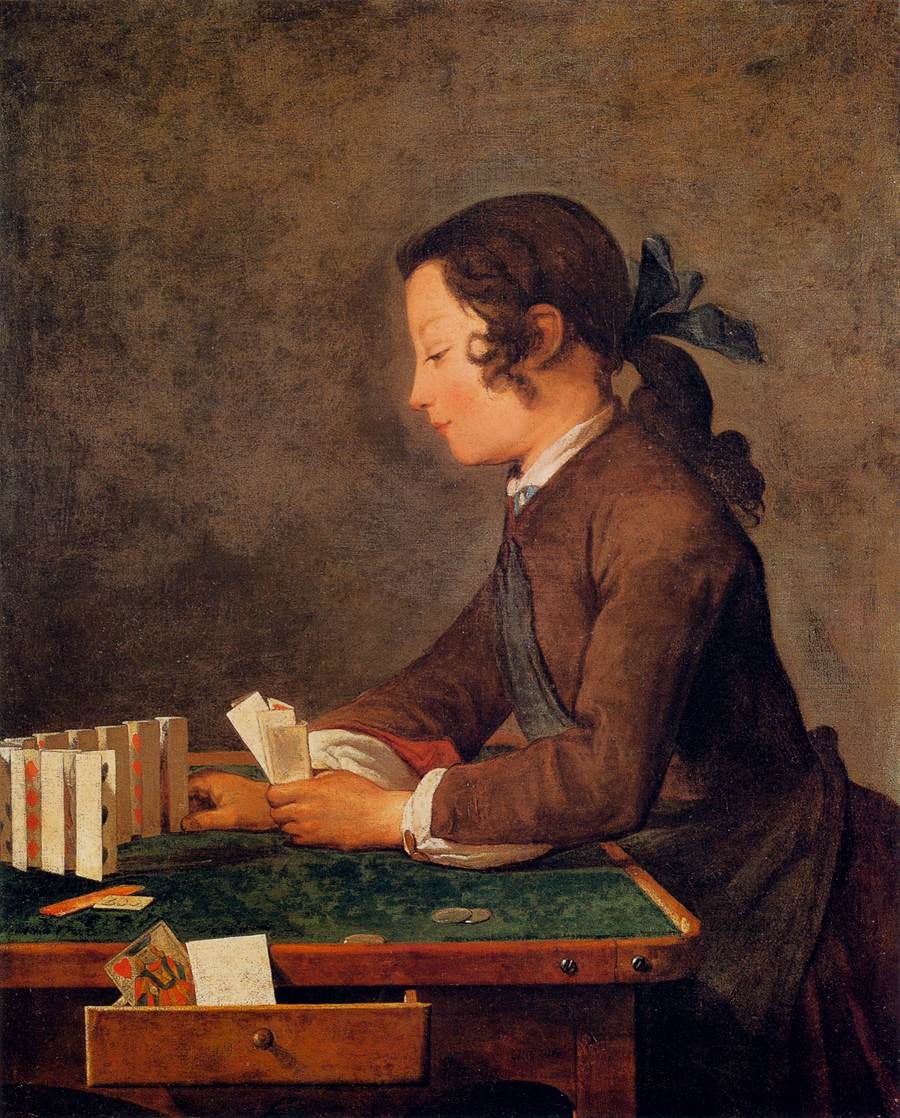
Lastly, infuse play in your life. The exemplification of this is Chardin’s House of Cards, where he paints a boy constructing a house of cards, bent over a table with a card in hand- he’s doing something useless yet appears grossly engrossed in it. This is where you have a long lunch doing nothing, have wandering conversations, watch good film, or just read without extracting any lesson.
However, dear - I’d be remiss if we didn’t diagnose and treat the root cause of your restlessness. Even if you know what to do, it’s also important to know why you keep seeking distractions. Perhaps you keep procrastinating because you’re afraid of failure, or you’re biting more than you can chew. Maybe you don’t have boundaries with your phone because you’re a chronic people pleaser.
These reasons deserve a closer look and The Stoic Workbook below will help you examine yourself, identify what your ailment is and get a personalized remedy for when you’re distracted without purpose again. Please, bring a pen and notebook with you.
September 29 — Epictetus on the cost of losing your attention
Epictetus, Discourses 4.12
“Once you let your attention wander, do not assume you can recover it whenever you wish. What you repeatedly permit becomes easier to repeat. The condition of the mind is shaped by what you practice.”
Socratic questions for a better life,
What risk does giving your full effort and commitment expose you to? Would you discover that…