


Welcome, dear reader! Practicing Stoicism can make us more aware of other people’s faults while giving us sensible rationalizations for our own. We become proud of our discipline, impatient with their emotions, and convinced that our harshness is helping. It’s worth examining how the desire to become better can leave us harder to trust, less empathetic, and increasingly unable to inspire goodness in others. If you missed the last edition on Why a “Boring” Life Might Be the Happiest One, you can catch up right here.

“When someone’s fault offends you, immediately turn to yourself and consider what similar mistake you make.” - Marcus Aurelius, Meditations, 10.30.
“If we want to judge fairly everything that happens, we must first convince ourselves that none of us is faultless.” - Seneca, On Anger, 2.28.
I once knew a person who considered himself a good and solid man, focused on truth-telling, hard work, and being honest. Granted, he does a wonderful job at most things. He’s energetic and intentional in his actions. But sometimes he uses other people’s shortcomings as a bridge to elevate his social status. Whatever admiration was due from me got interrupted by a more personal concern- if I’m your close friend and I see you doing that shit to another, what would you say about me now that you know so much?
It didn’t inspire trust or the spiritedness of connection. Because I wanted to be fully myself around a friend, where, yes, judgment is allowed if it leads to wise counsel. But I’d like to know that something I confided in a difficult moment won’t be offered to the highest bidder, or to whoever could give you the most advantage for sharing it.
And having recognized this in someone else, I have to look at the mirror on the wall.
you’re also human, all too human
I once considered people too far gone to be set on the right path. Undisciplined, less courageous, weaker. At first, practicing Stoicism made this worse because it became easy to see people’s pitfalls. Before understanding someone’s emotions, I was giving them advice. Before gauging their interest in something, I’d consider them lazy.
It was an embarrassing way to practice this beautiful philosophy.
Until I realized I was capable of some of the same things I condemned. I could dream about how I wanted to be great while sleeping in. I could recognize the temptation to protect my image at someone else’s expense. I could complain and let my emotions get the best of me.
What I hadn’t understood before was that there can be a painful history behind someone’s behavior- humiliation, fear, pain, old habits. We won’t always know, and we shouldn’t invent explanations for them. But listening in a non-judgmental way gives us a chance to find out.
The cognizance of our mistakes and how fucked up we are should make us kinder.
people stop telling you things
As a doctor, I can see how expensive that disconnect with people you feel better than could become. Imagine a young patient who has taken some drugs they’re ashamed to admit and now needs treatment. The doctor asks what happened, hears the first uncomfortable detail, and begins lecturing. Then the patient retreats into a more respectable account but the doctor continues the consultation with less information than would be useful.
A manner that makes honesty feel unsafe works against the very purpose of asking.
Something similar can happen at home. A child admits a mistake, the parent responds as though they’ve committed espionage, and this destroys trust such that the kid has to figure things out on their own. In a messy and sometimes dangerous way. Eventually, the parent sees fewer confessions and mistakes this for improvement.
We can even make change seem pointless. If every failure confirms that someone is the bad person we’ve already decided they are, they may grow tired of trying to prove otherwise. Shame becomes exhausting; defiance offers relief. They begin taking pride in the very behavior we wanted them to leave behind.
It’s good to remember that people remain responsible for their choices. And our influence depends partly on whether they can bring us the truth. Ostracize someone, make every encounter a judgment of their character, and you may lose opportunities to reach them. That’s why sometimes enjoying their company, taking an interest in what absorbs them, and having fun together makes a difficult conversation possible later. Then, and only then, can they be receptive to your concern.
the illusion of goodness
A man is about to be executed for getting his fiancée pregnant, and his sister’s best hope is to persuade the official who sentenced him to show mercy.
This is the situation in Shakespeare’s Measure for Measure where the Duke of Vienna has handed authority to his deputy, Angelo, a man respected for his discipline and strict morals. Angelo begins enforcing a neglected law against sex outside marriage. And unfortunately, Claudio, whose pregnant fiancée makes their offense impossible to conceal, is sentenced to death.
His sister Isabella is preparing to become a nun when she hears the news. She goes to Angelo and begs him to spare her brother. He refuses. The law has been broken, and Claudio must face the consequences. Isabella persists, asking Angelo to examine his heart and reconsider.
As she speaks, Angelo begins to desire her. He tells her to come back the following day.
Isabella returns hoping her appeal has worked. Instead, Angelo offers her a bargain- if she sleeps with him, he’ll let Claudio live. The official preparing to execute her brother for sex outside marriage is now demanding sex as the price of his release.
She refuses and threatens to tell everyone what he’s asked of her. Angelo’s response makes her situation more desperate- who will believe her? His reputation, his position, and his record of strictness will count against her accusation. He’s confident that people will find it easier to believe she’s lying than that a man like him could do such a thing. Then he threatens to have Claudio tortured if she won’t agree.
Isabella goes to the prison to tell her brother what happened. She expects him to share her horror and accept death before allowing her to be coerced. And at first, he does. Then the fear of dying takes hold, and he begs her to save him by agreeing. She sought mercy for her brother and now finds herself under pressure from him as well.
What Angelo doesn’t know is that the duke has remained in Vienna, disguised as a friar. He learns what’s happening, intervenes to save Claudio, and eventually exposes Angelo. Now the man who’d been so certain of his right to condemn others has to confess his wrongdoing.
Angelo had an opportunity to recognize himself in the man he was punishing. Feeling the desire he’d condemned could have made him reconsider his severity. Instead, he used his authority to pursue it and trusted his reputation for goodness to protect him. Other people’s belief in his virtue had become an advantage he could exploit.
That’s the danger of becoming attached to the idea that you’re a good person. You can grow more concerned with defending that identity than examining and dealing with the reality of who you are. An apology threatens the image; an excuse preserves it. Over time, you become practiced at protecting yourself from the very judgment you so confidently apply to others that it blows into the darkness that destroys your life.
what you can do
Of course, you still need to recognize wrongdoing, uphold high standards, and tell people the truth, even when they’d rather avoid it. Kindness requires enough courage to have that conversation. To exercise justice. Human dignity and freedom deserve protection, and serious harm should demand immediate consequences.
But for ordinary failures in people I care about, I’d rather begin by examining whether they understood the situation, the stakes, and what we were trying to accomplish. Perhaps I expected something I never explained. Perhaps I’ve judged their effort without understanding what it costs them- of which I ask what help they need to do better. And if the pattern continues, I can make the repercussions clear and follow through.
That requires humility.
We can always decide how much to work with someone, how much to share, and how close to remain to them, while accepting their limitations. Some people won’t constitute good company for us. We can leave them alone. We don’t have to carry them in our minds.
For at the end of the day, they’re their own business, and we can only do so much to help them.
give yourself the gift of self-reflection
Our daily conduct gives us enough to work with. The unnecessary joke. The confidence we betrayed because the story was too good. The person we dismissed before asking what happened. These things become easier to overlook when someone else is always doing something worse.
But imagine looking at your actions, reflecting, making reparations, and doing better for a year. Imagine how much could change if noticing your faults reliably led to a bonding conversation, an apology, or a different choice and habit. That’s what would happen if we redirected that judgment to ourselves.
Above all we should enjoy the comedy of human nature, including the parts we contribute ourselves. We won’t make it out of here alive. It doesn’t matter if we feel higher and mightier than the clouds; we share the same fate as all humans, and I don’t see a reason why much of our brief time here together could not be more generous, more interesting, more fun.
So the next time someone opens up to you, , remember they may already expect to be condemned. Surprise them. Give them enough room and grace to tell you the whole story, and see what the two of you can do from there.
‘Til next time. Have a good day ahead!
My books:
The Tools — Ambition asks a great deal of your mind and body. I wrote The Tools to help you meet those demands. It covers how dopamine shapes motivation, how to structure your day for deep work, and how to use exercise, nutrition, sleep, and Stoic practice to sustain your energy when the work gets hard.
The Best of Marcus Aurelius — I’ve read Meditations more than a hundres times. What’s in this book are the passages I keep coming back to, arranged around eleven themes so you can find Marcus when you need him most. Open it when someone has tested your patience, when pain becomes too much, or when you’ve been so busy getting through the day that you’ve missed what was beautiful about it.
You can buy either book on its own. Both are included with an annual or lifetime membership to The Stoic Manual.
Our Stoic Community:
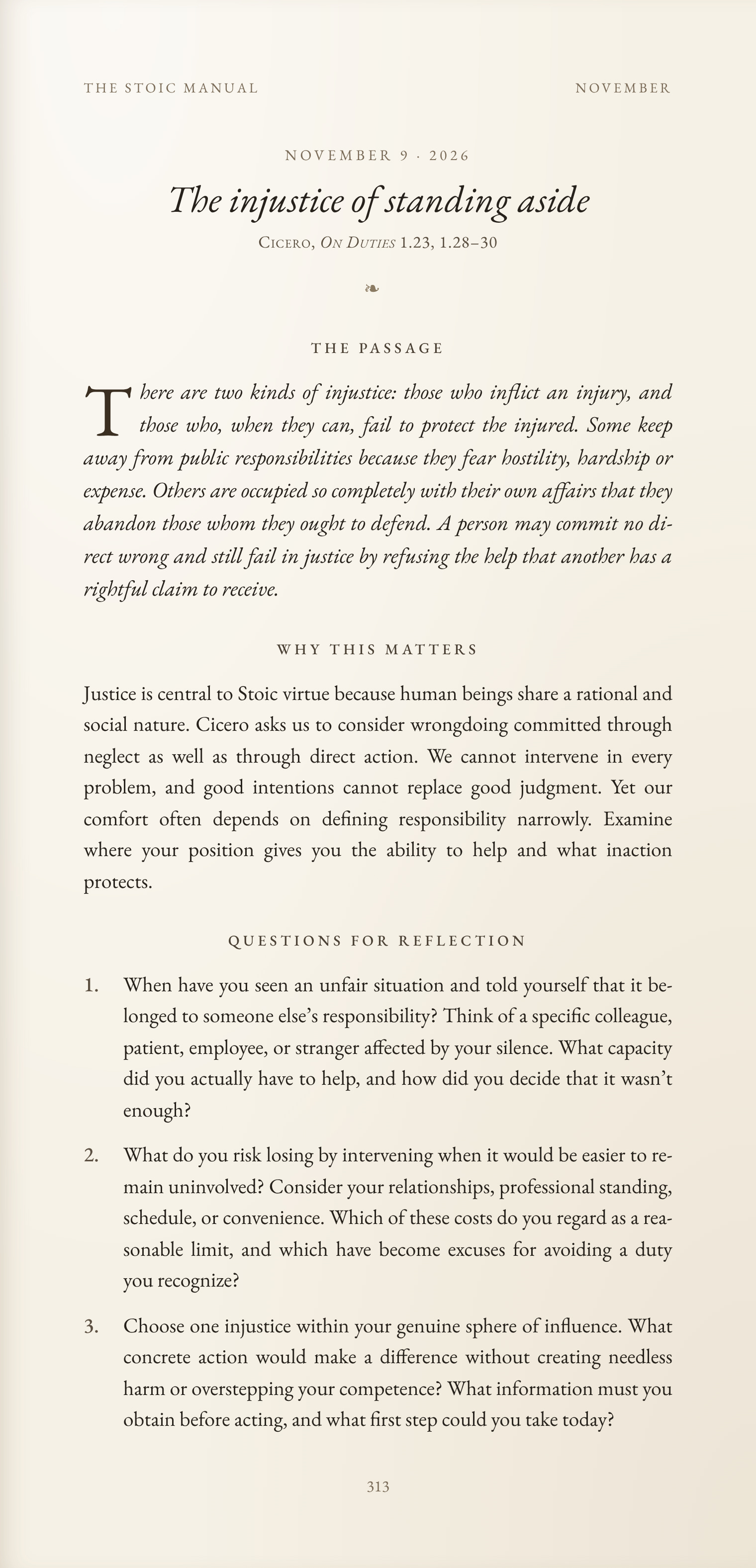
It’s easier to read about Stoicism than to practice it. I’d love for you to join me and other paid readers for a few minutes of practice each day in the Stoicism Together Club. Here’s an example of what we do,
With love,
Antonius Veritas, M.D